Watch Checker: How to Verify a Watch from Photos
Learn what a watch checker can reliably identify from photos, which clues matter, and the quick checks to run before you act on a watch photo.
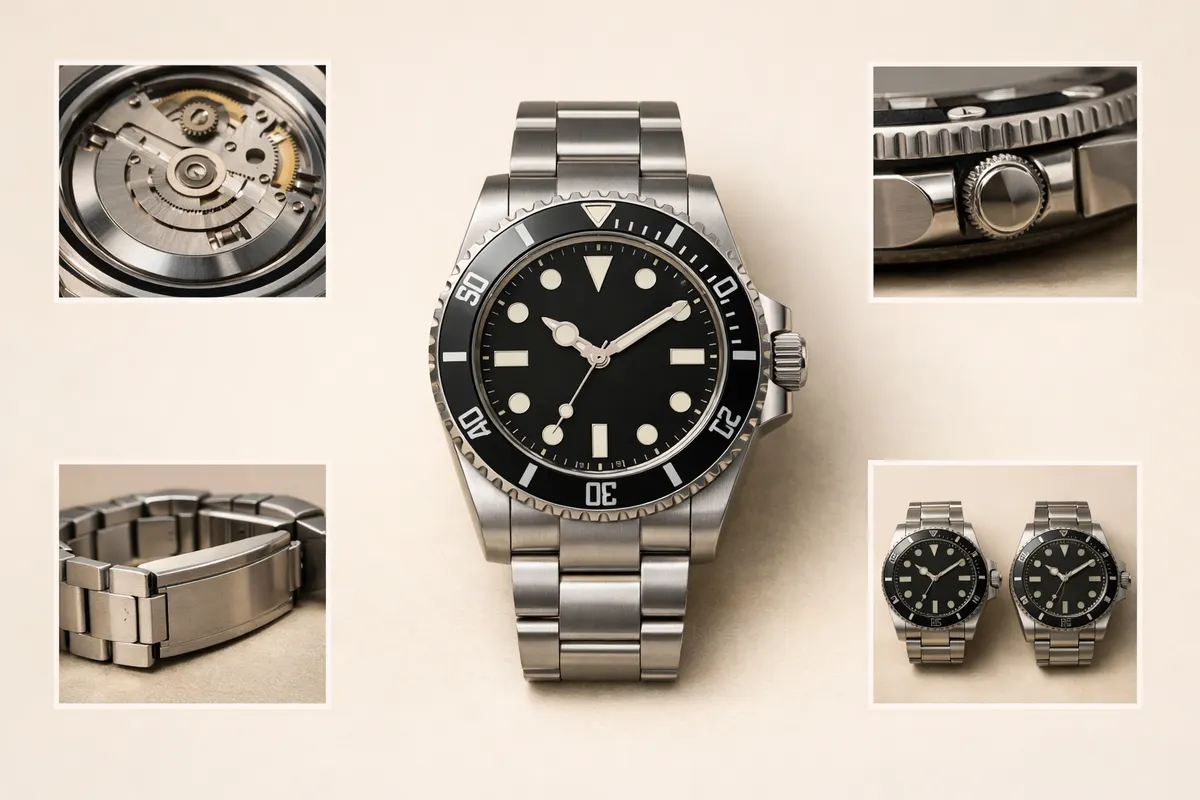
Quick answer: What a watch checker can do
A watch checker uses the watch photo and context to confirm a few visible things quickly: brand logos or dial text that match known designs, obvious dial and hand configurations, bracelet and clasp styling, and sometimes case shape or bezel markings that narrow the model family. In many cases a watch checker can tell you the likely brand or whether a watch is a known replica pattern, but it rarely produces a definite appraisal or guaranteed authenticity from a single photo.
Photos often let a watch checker eliminate impossible matches faster than they can confirm a single precise model. For example, a clear photo of a distinctive crown logo plus a unique handset can point strongly to one brand. Conversely, watches with generic dials or heavy aftermarket modification will remain ambiguous even with good images.
If you need to act — buy, sell, or insure — treat the watch checker as a fast first pass. It speeds up your next steps by highlighting the strongest clues to verify in person or with paperwork: serial numbers, caseback stamps, movement photos, provenance, and service records. Use the results to decide whether a closer inspection or expert appraisal is warranted.
What 'watch checker' means in practice
The term watch checker is shorthand for a practical, photo-first verification: a quick assessment that pulls visual clues and contextual data together to estimate what a watch is and whether anything looks off. It is not a legal or market appraisal; rather, it’s a diagnostic triage that helps you prioritize follow-up steps.
A watch checker combines four sources of information: the watch image(s), the photo’s metadata and context (where/when the photo was taken, who posted it, and any listing text), knowledge of common model traits for the suspected brand, and known lookalike patterns used in counterfeits or aftermarket modifications. The output is a confidence-based suggestion, not a certificate of authenticity.
For collectors and buyers, the practical value is decision speed. A careful watch checker can flag red flags before you spend time or money: wrong fonts on a dial, mismatched lug end shapes, non-original hands, or an uncommon case thickness. For casual curiosity it often confirms brand identity on obvious models.
Key clues a watch checker looks for in photos
A few visual details consistently carry the most weight. A clear, unambiguous logo on the dial or crown is strong evidence for brand identity when the typography and placement match catalog images. Dial text that includes model names or depth ratings can also narrow the search to a model family.
Case and bezel design are especially helpful when the brand uses distinct silhouettes: cushion cases, onion crowns, coin-edge bezels, or specific tachymeter scales. Bracelet and clasp construction, end-link fit, and how the bracelet integrates into the case often reveal whether the bracelet is original or aftermarket.
Movement-level clues are the gold standard for verification but require additional photos. Visible movement finishing, rotor shape, balance bridge and serial numbers inside the caseback are high-confidence indicators when available. If you can’t get movement photos, the next-best evidence is consistent, high-quality exterior details.
- Dial logo and typography: check font, spacing, and placement against reference photos.
- Handset and indices: unique shapes (syringe hands, Mercedes hour hand) narrow possibilities.
- Bezel markers and insert: font style, chip pattern, and lume plots are brand/model cues.
- Case shape and lug dimensions: measure or compare silhouette against known examples.
- Bracelet end links and clasp code: original hardware often carries maker marks.
- Crown and crown guards: position and engraving can point to specific lines.
- Caseback stamps and serials: high-confidence when legible and matched to records.
- Movement pictures: rotor engraving and bridge layout are the most conclusive visible proof.
Step-by-step watch checker workflow
Start with the best photos you can get. A watch checker is only as good as the images and context. Request straight-on dial shots in natural light, a 45-degree case angle, caseback, crown, clasp, and any paperwork or seller-provided provenance. If possible, include a simple ruler or coin for scale.
Inspect the dial at 100% zoom for logo shapes, dial printing quality, and the lume application. Compare those traits to catalog or auction images for suspected brands. Look for uneven printing, incorrect fonts, or inconsistent spacing—these are fast indicators that something is off. Note any mismatch in handset length or seconds-hand tip shape.
Check the case and bracelet next. Confirm end-link fit, lug curvature, bezel seating, and crown engraving. If the bracelet or clasp shows aftermarket signs—poor end-link gaps, mismatched serial codes, or wrong clasp engraving—treat exterior ID as partial and keep digging for movement photos.
If the seller can open the caseback or provide a movement photo, examine rotor engraving, bridge geometry, and serial numbers. Cross-check those numbers with known records or the manufacturer's guidance where possible. If movement photos are unavailable, prioritize an in-person inspection by a trusted watchmaker before high-value transactions.
Document your findings and assign a confidence level: high (strong matching logos, original movement photos), medium (good exterior match but no movement or caseback), or low (smudged photos, obvious aftermarket parts, or generic design). Use that confidence to decide the next step: offer, negotiate, request more proof, or walk away.
- Collect clear: dial front, 45° case, crown, caseback, clasp, and scale reference.
- Zoom and compare: fonts, spacing, and lume under good light.
- Case & bracelet check: end-link fit, clasp codes, and lug geometry.
- Movement proof: rotor engraving, bridge layout, and serial numbers when possible.
- Assign confidence: high, medium, or low to guide your next action.
Examples: common watch-checker scenarios
Scenario 1 — Easy brand ID: A seller posts crisp photos of a diver with a unique handset, bold printed brand logo at 12 o’clock, and a bezel with a distinct coin-edge and triangle lume pip. The bracelet shows a stamped clasp with a manufacturer code matching catalog examples. With those photos a watch checker can reliably call the brand and likely model family at medium-to-high confidence, though movement photos would be needed for full authenticity.
Scenario 2 — Likely aftermarket: A vintage dress watch photo shows dial printing that appears slightly misaligned and hands that don’t match period examples. The caseback is polished smooth without original stamps. Here the watch checker flags aftermarket dial replacement or refinishing. The result is not a final judgment of value, but a strong cue to request movement photos and provenance before purchase.
Scenario 3 — Replica pattern: A watch photo of a popular luxury diver shows dial text with tiny font differences and a crown logo that is almost correct but with subtle curvature errors. The bezel insert font weight differs from genuine examples. These are classic cues of a high-quality replica. A watch checker will mark the listing as high-risk and recommend walking away or getting an expert physical inspection.
Scenario 4 — Ambiguous modern generic: A microbrand uses a common case and dial layout with no clear logo or serials visible. The photo quality is poor and the clasp is unbranded. The checker can only state that the watch likely belongs to a broad group (e.g., modern three-hand divers) and that more evidence is needed for a precise ID.
- Clear logo + original clasp = strong brand ID (still verify movement for authenticity).
- Misaligned printing or mismatched hands = likely refinished or aftermarket dial.
- Subtle logo shape errors + bezel font differences = possible replica pattern.
- No markings and poor photos = low-confidence result; request better evidence.
Limitations
Photos cannot always show what matters most. Internal movement condition, provenance paperwork, and repair history are frequently decisive for value and authenticity but are invisible or absent from simple photos. Even high-resolution exterior images can be misleading when parts are swapped, refinished, or when aftermarket components mimic original styles.
Confidence is also limited by model complexity and known lookalike markets. Some brands use generic dials and common cases that many makers copy; in those cases a photo-based watch checker may only produce a tentative family-level ID. High-value luxury models and vintage pieces with cloned parts demand movement-level proof or a trusted third-party appraisal.
Human factors matter: seller intent, listing context, and image editing can misrepresent condition or scale. Metadata and additional context help: ask for receipts, service records, original boxes, and a short video of the watch running. When a transaction exceeds your risk tolerance, the sensible path is an in-person check by a trusted watchmaker or an accredited authentication service.
- High-value or rare watches usually need movement photos or a service history for reliable authentication.
- Refinished dials and swapped parts can fool exterior-only checks; movement verification reduces that risk.
- Poor photo quality, heavy editing, or missing context lower confidence—ask for better evidence.
- When in doubt, prioritize a physical inspection by a horologist before large purchases or sales.
Take the fastest next step with Watch Scanner - Watchsy
If you want a quick, photo-first check, use the Watch Scanner - Watchsy app on iOS to scan your watch photos and get a prioritized list of visual clues and likely matches. Start with clear front, crown, and caseback shots; the app helps highlight the features to verify and suggests the next steps—request movement photos, ask the seller specific questions, or get an expert inspection. Treat the app’s result as an informed first pass: it speeds decision-making but does not replace movement-level verification or professional appraisal.

Frequently asked questions
Can a watch checker tell if a watch is fake from a photo?
A watch checker can spot many visual signs of a fake—incorrect logo shapes, wrong fonts, bezel insert differences, and handset mismatches are common giveaways. High-quality replicas may still evade exterior-only checks, so a photo-based checker assigns confidence rather than absolute certainties. For definitive authentication, movement photos, serial checks, and a physical inspection by a trusted expert are necessary.
What photos should I send to get the best watch checker result?
Provide a straight-on dial shot in natural light, a 45-degree case angle, clear photos of the crown and crown guards, the caseback (inside and outside if possible), clasp and bracelet close-ups, and a movement photo if the caseback can be opened safely. Include a scale reference (ruler or coin) and any paperwork or seller notes. Better context and more angles raise the checker’s confidence significantly.
How much can a watch checker estimate the watch’s value?
A watch checker can give a rough market-range based on model recognition and visible condition, but it cannot replace an appraisal. Value depends on movement authenticity, service history, provenance, and sometimes subtle production variations only visible internally. Use the checker’s estimate only as a starting point; get a formal appraisal or consult recent sale records for accurate valuation.
When should I walk away after a watch checker report?
Consider walking away if the checker highlights multiple high-risk indicators—mismatched dial text, incorrect bezel fonts, aftermarket parts, and a seller who refuses movement photos or provenance. Also be cautious when photos are low-quality, metadata is missing, or the seller pressures you for a quick sale. For expensive purchases, insist on movement verification or an in-person inspection before committing.