
How to Identify a Watch: Photo Clues, Steps, and Limits
Learn what a photo can prove when you want to identify a watch, which visual clues matter, and sensible next steps before you rely on an ID.
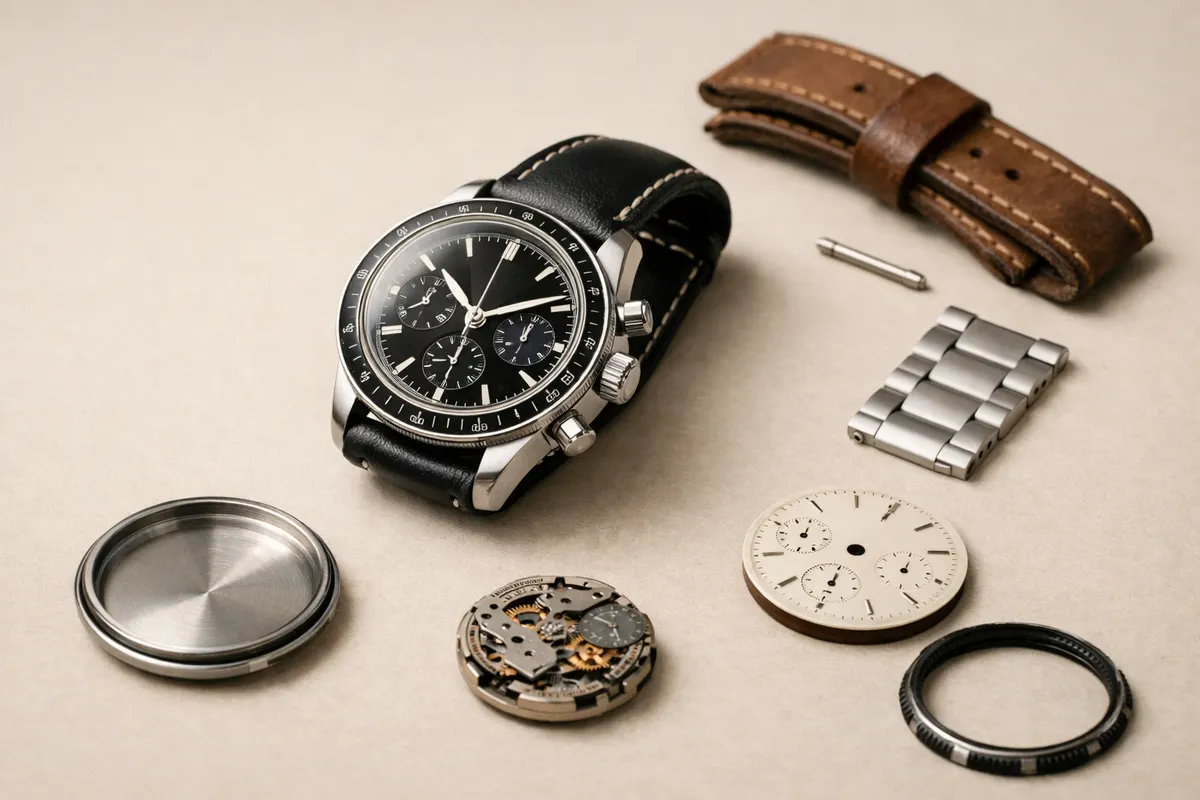
Quick answer: what a photo can show when you try to identify a watch
If your goal is to identify a watch from photos, start by accepting one core limitation: a single photo can often reveal model family, dial design, and visible markings, but rarely proves provenance, recent service history, or internal movement without further evidence. To identify a watch from images reliably, combine clear close-ups of specific parts with context shots and any paperwork or serial numbers you can find.
For a practical first pass, use the photos to rule in or out likely brands and families, flag lookalikes, and collect the clues a specialist or a photo-identification tool needs. Watch Scanner - Watchsy is useful at this stage as a structured way to compare photos and surface candidate matches, but treat its suggestions as leads you verify with the watch itself or a trusted dealer.
- Photos can usually show dial layout, logo, hands, bezel style, and case shape — these narrow the search quickly.
- A clear serial number, hallmarks, or a movement photo are the strongest single-image proof points for a confident ID.
- Use photos to sort plausible matches and to decide whether the watch needs an in-person inspection or paperwork check.
Watch identification guide: what identifying a watch involves
Identifying a watch means moving from “unknown” to a set of plausible, evidence-backed possibilities: brand, model family, approximate era, and—when available—exact reference or movement. In photo-based work we separate what is probable (stylistic family, logo match) from what is definitive (serial number, movement markings, original purchase documents).
A practical watch identification guide treats photos as one layer of evidence. Good images reduce the candidate pool and expose lookalikes, but they rarely replace hands-on checks for authenticity or condition. For example, a dial that reads “Submariner-style” narrows the field but does not distinguish genuine Rolex from aftermarket or homage pieces.
Watch identification also has a context dimension: where the watch came from, accompanying box papers, and previous service receipts all raise or lower confidence. When you work with Watch Scanner - Watchsy or a photo-first expert, treat the app’s results as starting points for these contextual checks rather than final proof.
- Expectation: photos often yield brand-family suggestions, not final authentication.
- Value of documentation: paperwork or a service history can convert a photo-based ID into a high-confidence claim.
- Context matters: seller history, provenance, and where the watch surfaced are part of the identification package.
Watch visual clues to check first in every photo
Start by scanning for immediately recognizable visual cues: the logo or signature on the dial, handset shape, indices or numerals, bezel type and markings, and case silhouette. These watch visual clues are the fastest way to narrow which brands or model families belong on your shortlist.
Next, inspect finer marks that experienced observers use: crown guards shape, lug hole spacing, the presence and style of a date window, font style on the dial, and subdial layouts for chronographs. Small details like the edge finish of the bezel, the lume plots’ shape, or whether the seconds hand has a lollipop tip can separate lookalikes.
Photographs that include the caseback, clasp, or movement give stronger evidence. Caseback engraving, hallmarks, inside-caseback codes, or movement bridges with serials are far more diagnostic than dial styling alone. If a photo shows an embossed or stamped brand name on the rotor or a visible balance bridge design, that can move an identification from probable to likely.
- Dial logo and typography — clear and early indicators of brand family.
- Handset style — sword, dauphine, baton, cathedral often match particular eras or lines.
- Bezel type and markings — dive bezels, tachymeter rails, or smooth fluted bezels point to specific model types.
- Case shape and lug profile — cushion, tonneau, round; size and curvature affect match accuracy.
- Crown and crown guards — presence, shape, and logo engraving add discriminating detail.
- Caseback, clasp, and movement photos — provide the highest-confidence visual clues when visible.
Step-by-step workflow to identify a watch from photos
1) Collect the right photos. Aim for a set that includes a straight-on dial shot, a macro close-up of the logo and any serials, a side profile showing the crown and case thickness, the caseback, clasp, and a movement photo if the caseback is open. Good lighting, a neutral background, and a coin or ruler for scale can all improve the result.
2) Record context. Note any engraving, paperwork, seller notes, where the watch was found, and the watch’s dimensions if available. This context helps separate identical-looking modern homages from older originals; a stated origin or era can eliminate many false leads.
3) Run a first-pass visual comparison. Use descriptive search terms based on the strongest visual clues (for example: “black dial diver with Mercedes hands and coin-edge bezel”) and compare candidate images. Watch Scanner - Watchsy’s Find This Watch tool can help surface visually similar matches quickly — treat them as candidates not confirmations.
4) Escalate to higher-proof evidence when needed. If confident identification matters (for sale, insurance, or repair), request a photo of the movement serial or have a watchmaker open the case to inspect movement numbers and maker marks. For vintage pieces, movement caliber and caseback stamps are often decisive.
- Collect: dial, bezel, side profile, caseback, clasp, movement (if possible), and scale reference.
- Note provenance: seller details, paperwork, purchase receipts, and service history when available.
- Compare visually: match multiple small details, not just the logo or overall look.
- Verify: when stakes are high, seek movement photos or professional inspection for authentication.
Examples
Example 1 — Brand match from dial and hands: A photo that clearly shows a signed dial, distinctive handset, and a branded crown often lets you identify the brand and a likely model family. For example, a sunburst blue dial with broad arrow hands and a triangle marker at 12 narrows the field to a handful of known pilot-style models.
Example 2 — Lookalike danger: Homage or aftermarket-dial watches can imitate original designs closely. Two photos that look identical at a glance — same bezel shape and dial text — can still differ in case thickness, crown engraving, or movement type. A second photo of the caseback or movement frequently exposes those differences.
Example 3 — Vintage ambiguity: For old watches with worn or refinished dials, photos can mislead. A refinish can change fonts and lume color and hide manufacturer marks. In these cases, a movement photograph or provenance documents are the tipping evidence that turns a probable ID into a confident one.
- Clear signed dial + logo + crown engraving = strong brand-level match in many modern watches.
- Identical styling but different caseback marks = common sign of homage or replacement components.
- Vintage watches with refinished dials require movement photos or paperwork for reliable ID.
Limitations: what photos usually can’t confirm about a watch
A photograph alone rarely proves authenticity beyond doubt. Many counterfeiters and aftermarket modifiers focus on dial and bezel appearance because those are the details buyers notice first. Without movement photos, serial verification, or paperwork, any photo-based identification should remain labeled as provisional.
Condition and service history are also difficult to verify from images. Surface scratches, replaced parts, or refinished dials can be masked by angles, lighting, and post-processing. Photos can under- or over-state wear; in-person inspection reveals whether parts are original, worn, or replaced.
Legal or market value determinations should not rely solely on images. If you need the watch identified for sale, insurance, or legal purposes, combine photographic IDs with a trusted watchmaker’s inspection, serial checks with the brand (when possible), or provenance documents. Watch Scanner - Watchsy helps prioritize leads, but it does not replace hands-on verification.
- High confidence: movement serials, inside-caseback marks, and original paperwork.
- Partial confidence: several consistent photos showing caseback, clasp, and hallmarks.
- Low confidence: a single dial photo or pictures showing only stylistic similarities.
- When to get professional help: suspected high value, unique vintage references, or possible fakes.
Related guides
Run a first-pass match with Watch Scanner - Watchsy
If you’ve gathered clear photos and want a structured first pass, try the Find This Watch tool at https://watchscanner.app/tools/find-this-watch. Use it to surface visually similar candidates and compile the evidence points you’ll need next. Treat the tool’s suggestions as leads to verify with movement photos, paperwork, or an expert when the watch’s origin or value matters.
Take the next step →Frequently asked questions
How many photos and which angles do I need to identify a watch reliably?
Aim for at least six focused photos: a straight-on dial shot, a macro of the logo and any text, a side profile showing the crown and case thickness, the caseback, the clasp or bracelet end links, and a movement shot if you can open the case. Including a small ruler or coin for scale and photographing any paperwork or serials raises confidence. These images let a photo-identification tool or a specialist cross-check multiple visual clues rather than relying on one ambiguous view.
Can a photo prove a watch is authentic or is it only for identification?
A photo can strongly suggest authenticity when it shows brand-specific movement markings, serials, and original factory stamps, but it seldom proves authenticity alone. Counterfeit and refurbished parts can mimic visual cues. When authenticity matters (sale, insurance, or estate appraisal), use photos to narrow candidates and then verify with movement inspection, serial verification with the manufacturer, or an experienced watchmaker’s report.
How do watch types affect identification when I only have photos?
Different watch types change which details are most diagnostic. Dive watches are often identified by bezel style, crown guards, and water-resistance markings; chronographs require clear views of subdial arrangement, pusher shape, and tachymeter text; dress watches rely more on case proportions and dial typography. Knowing the watch type from the photo focuses which clues to prioritize and which lookalikes to watch for.
What should I do if the dial has no brand or the watch looks modified?
When the dial is unsigned or the piece appears modified, broaden your search to component-level matching: examine bezel fit, lug spacing, crown tube style, and movement layout. Photograph the movement and inside the caseback if possible; these often retain maker marks even when external parts have been changed. If internal inspection isn’t possible, document seller history and any provenance to offset the missing visual cues, and consider a hands-on appraisal for conclusive answers.