How to Identify a Vintage Watch: Visible Clues and Records
A clear process to identify a vintage watch from visible dial, case clues and maker records, plus practical next steps and verification limits.
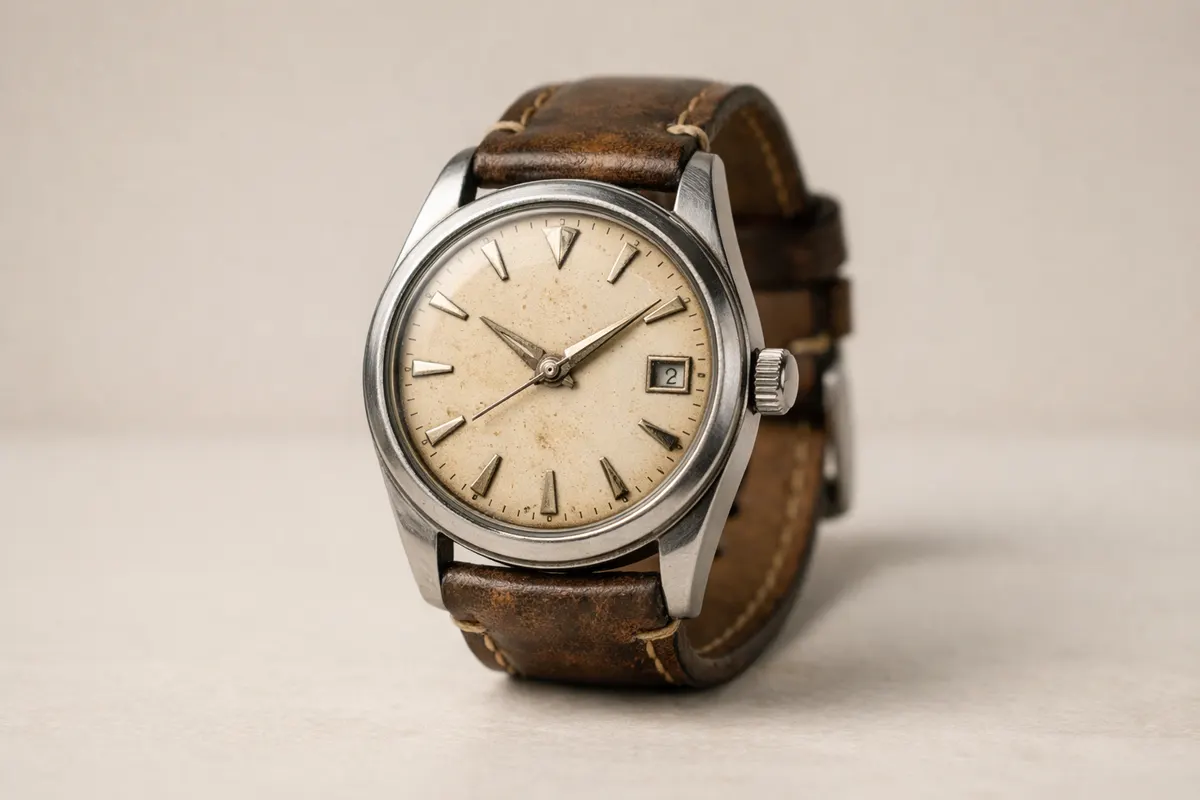
Quick answer: identify a vintage watch from visible clues
How to identify a vintage watch starts with careful observation: photograph the dial, caseback, lug area and any markings, then read those details against manufacturer references and period catalogs. Visible clues—brand logo, dial typography, hand style, bezel type and case shape—often narrow the model and decade but rarely confirm provenance or value on their own.
A practical two-step approach works best: first transcribe every legible marking and visible specification from the watch, then run those data points through maker histories, serial ranges and trusted reference databases. Treat photographic evidence as a starting point—use it to build a short list of candidate models, not a definitive identification.
What it means to identify a vintage watch visually
Identifying a vintage watch visually means converting what you can see—fonts on the dial, trademarked logos, case shape and material, indexes, and crown style—into informative search terms. These visible features are surface-level evidence that point toward specific models, production eras, and factory options; they do not, by themselves, prove authenticity, manufacture date, or market value.
Manufacturer records, original catalogs and movement markings are the complementary evidence that help tighten an ID. For many collectible brands, a serial number range or movement caliber noted in manufacturer archives can confirm a likely production window. Because access to those records varies by brand and era, most identifications are probabilistic: you gather high-confidence matches (e.g., exact dial text and case reference) and lower-confidence cues (e.g., aftermarket hands, refinished dials).
Putting the visible evidence and documentary records together creates a layered conclusion: a visible match may let you say 'this appears to be a 1960s XYZ reference,' while a record match might raise confidence to 'likely produced in 1963, matching case and movement references.' Always state the level of certainty and the evidence that supports it.
Be careful to separate three information sources: what you see on the watch, what the seller or previous owner claims, and what independent archives or specialists confirm. Each source has different reliability and risk of error; the best identifications clearly list which conclusions come from which source.
Key visible clues that point to a model or era
Start with the dial. The brand logo, any text (model name, chronometer certification, depth rating), font style, subdial arrangement and hour markers are among the strongest model clues. For example, a dial that reads 'Oyster Perpetual' with gilt printing and applied baton markers suggests an early mid‑century Rolex pattern; the same text in modern lume paint indicates a different production era or a service dial.
Examine case details: the case shape (rounded, tonneau, cushion), lug style, bezel type (smooth, fluted, rotating), and caseback markings often map directly to manufacturer references. Case material markings—stamped gold hallmarks, steel codes or plating marks—help determine original construction. Remember that cases can be swapped, so pair case clues with dial and movement evidence whenever possible.
Hands and indices offer strong era signals. Dauphine hands, syringe hands, cathedral hands and specific lume plots were popular in distinct decades. Matching hand shape and dial print style increases confidence, while mismatched hands or re-lumed markers lower it. The crown design and tube height also narrow down model families and vintage span.
Movement and caseback inscriptions are high-value clues when you can access them without opening the watch. External caseback engravings, reference numbers stamped between the lugs, and any visible movement serial/caliber through display backs (rare on vintage pieces) are among the most conclusive evidence collectors and registries use.
- Dial text and logo: brand name placement, wording changes, and printing style.
- Case reference and lug stamps: numbers between lugs or inside casebacks (note: do not open a case unless you are qualified).
- Hands and indices: original vs. replacement styles often indicate service history.
- Bezel and crown: rotating bezels, fluted bezels, signed crowns or unsigned replacements.
- Material hallmarks: gold hallmarks, plating marks, and steel codes visible on the case.
- Serial ranges and movement caliber: combine with published manufacturer tables where available.
Step-by-step workflow to identify a vintage watch
1) Photograph and transcribe everything visible. Create a simple worksheet with spaces for brand text, dial wording, hand type, index shape, bezel type, case material, any visible numbers and condition notes. Take clear photos from straight-on and 45° angles, plus close-ups of the dial, crown, caseback edge, and lug stamps. Transcribe the exact wording and numerals rather than paraphrasing.
2) Search maker references and catalog images. Use brand-specific reference books, online archives, and reputable collector forums to look up the exact dial script, bezel style and case shape. When a detail matches a manufacturer photo from a catalog or verified registry, record that source and page. Cross-check the same features across multiple references to avoid relying on a single, possibly incorrect image.
3) Narrow to candidate references using combined clues. Combine the dial text, case reference (if visible), movement caliber (if known), and serial range to form a short list of candidate references. If those elements converge on a single reference in reliable sources, you have a high-confidence identification. If they diverge—say, a case style from one reference and a dial that matches another—treat the result as a partial match and list possible explanations (case swap, redial, aftermarket hands).
4) Note provenance and seller claims separately. Record what the seller asserts—original box, service history, past appraisal—and treat these as claims until independently verified. Avoid posting serial numbers or private movement identifiers in public forums; if you need help, redact those numbers before sharing images, or share them only with trusted specialists or archives.
5) When to involve archives or professionals. If visible and reference-based searches leave uncertainty or if the watch is potentially high-value, consult brand archives (when available), certified watchmakers, or recognized registries. Request photos of the movement and inside caseback only when a qualified watchmaker opens the case and you both agree on privacy handling of serials and unique identifiers.
- Photograph everything and transcribe exact markings.
- Match dial typography and case features against catalogs.
- Combine dial, case and movement clues to narrow candidates.
- Keep seller claims and provenance notes distinct from visual evidence.
- Seek archives or professional help for high-value or uncertain IDs.
Examples
Example 1 — A mid‑century chronograph with matching dial and case: You have a 3-register chronograph with a telemeter scale, pump pushers and a signed dial printed 'Swiss Made' at 6 o’clock. The caseback shows a manufacturer reference between lugs that matches a 1950s catalog plate. Together, the telemeter dial layout, pusher style and matching case reference point strongly to a specific model family. That combination is high-confidence if movement caliber and serial ranges also align.
Example 2 — A watch with a redial and replacement hands: A watch shows a brand name and model on the dial, but the printing looks too bright and the hands are a different design than known examples. Reference pictures show a different hand set and aged patina on comparable originals. In this case, the dial or hands were likely refinished or replaced. The watch may still be the correct model, but you should downgrade the certainty and seek movement photos or archive confirmation.
Example 3 — Visual lookalikes and common misidentifications: Some brands produced models with nearly identical case shapes and dials in the same era; aftermarket parts and later service dials increase the risk. For example, a plain three‑hand steel sport case from the 1960s can resemble entries from multiple brands—only a combination of dial text, case reference, and movement caliber usually separates them. When visible clues are shared across manufacturers, expect a longer verification process.
Example 4 — When a serial range confirms the era: Suppose you can safely view a serial number (record it privately, do not publish it). If that serial fits a known production range in a brand's registry and the movement caliber matches the catalog for that range, your identification moves from probable to likely. Even then, avoid publishing the serial as unique proof; it supports the conclusion but does not replace professional authentication.
- High-confidence ID: matching dial text + case reference + movement caliber.
- Partial ID: matching dial and case but evidence of redial or swapped hands.
- Lookalikes: identical case shapes across brands require movement/records.
- Serial-range confirmation increases confidence but keep numbers private.
Limitations: what photos and visible clues cannot prove
A photo-based identification has important limits. Visible clues rarely prove authenticity, establish market value, or verify provenance alone. Redials, refinished case parts, aftermarket bezels and swapped movements can all create convincing but incorrect visual matches. Photos may hide restoration work, non-original parts, or internal changes that only an expert inspection or manufacturer archive check can reveal.
Unique serial numbers, production paperwork and original purchase receipts are sensitive identifiers. Do not publish full serials or unique movement numbers in public posts—treat them as private data. When you need to consult experts with serials, share them privately or redact digits not needed for a preliminary check. Manufacturer archives and brand services are the safest routes for serial-based confirmation, but access and turnaround vary by brand.
A worksheet and photos are an excellent first pass but should not be the final step for high-value purchases. When in doubt—significant price, rare reference, unclear provenance—arrange an in-person appraisal, ask a qualified watchmaker to photograph the movement and inside caseback, or request an official extract from the manufacturer if that service is offered.
Finally, avoid opening cases unless performed by a trained watchmaker. Opening a case without the right tools or sealing technique can damage the watch, invalidate certain warranties, or remove evidence. Use visual and archival methods first; treat invasive checks as a professional-level verification step.
- Photos cannot reliably prove authenticity or value.
- Do not post full serials or unique movement numbers publicly.
- Archive lookups and professional inspections are necessary for high-value items.
- Never open the case yourself—use a qualified watchmaker for internal checks.
Related guides
Try the Find This Watch tool for a structured first pass
After you’ve photographed the dial, case reference, and any visible markings, continue to the Find This Watch tool to run those details against curated references and model examples. Use the app as a first-pass aid to organize clues and generate candidate matches, then follow up with archive checks or a professional inspection for any high-value or uncertain identifications. Visit https://watchscanner.app/tools/find-this-watch to begin—keep serials private and reserve in-person checks for experts.

Frequently asked questions
Can I identify a vintage watch from photos alone?
You can often narrow a vintage watch to a small list of possible models from clear photos of the dial, caseback edge, lugs and crown, but photos alone rarely provide final proof of authenticity or value. Redials, swapped hands, aftermarket cases and refinished parts can create convincing visual matches. Treat photographs as a first-pass identification tool: use them to transcribe exact markings and to form candidate references, then confirm with movement photos, manufacturer records, or a professional inspection when the watch is potentially valuable or rare.
What specific photos should I take to help identify a vintage watch?
Take sharp, well-lit photos: a straight-on shot of the dial, close-ups of any text or symbols, a 45° angle showing the case profile, close-ups of lug areas (where reference numbers may be stamped), the crown, and the caseback edge or inside (if a professional opens it). Photograph any hallmarks, maker’s marks, or visible movement details only when the watch is opened by a qualified watchmaker. Always transcribe the exact wording and numerals visible in the images and keep sensitive serials private when seeking help.
How do I protect privacy when sharing watch serial numbers for identification?
Serials and unique movement numbers are sensitive identifiers. Avoid posting full serials in public forums. If an expert needs them for verification, share the numbers privately via direct message or email and ask how they will use or store that information. Redact parts of the number when asking for general help—often the production decade or range can be confirmed from a partial serial. When contacting brand archives or official services, follow their secure process for submitting serials and request written confirmation rather than public disclosure.
When should I get a professional to inspect a vintage watch?
Arrange a professional inspection when the watch could be high-value, when visible clues conflict, or when you need authentication for sale, insurance or estate purposes. Recommended steps include a certified watchmaker opening the case to photograph the movement and inside caseback markings, consulting brand archives for serial-range confirmation, and obtaining a written condition and authenticity report. For lower-value or common watches, a well-documented visual ID and good references may be sufficient for casual collecting, but any high-stakes transaction benefits from expert verification.