
Watch Parts Names: The Visible Details That Help Identify a Watch
Learn watch parts names and how visible dial and case details help identify a watch. Practical checklist, comparison tips, and safe next steps for photos.
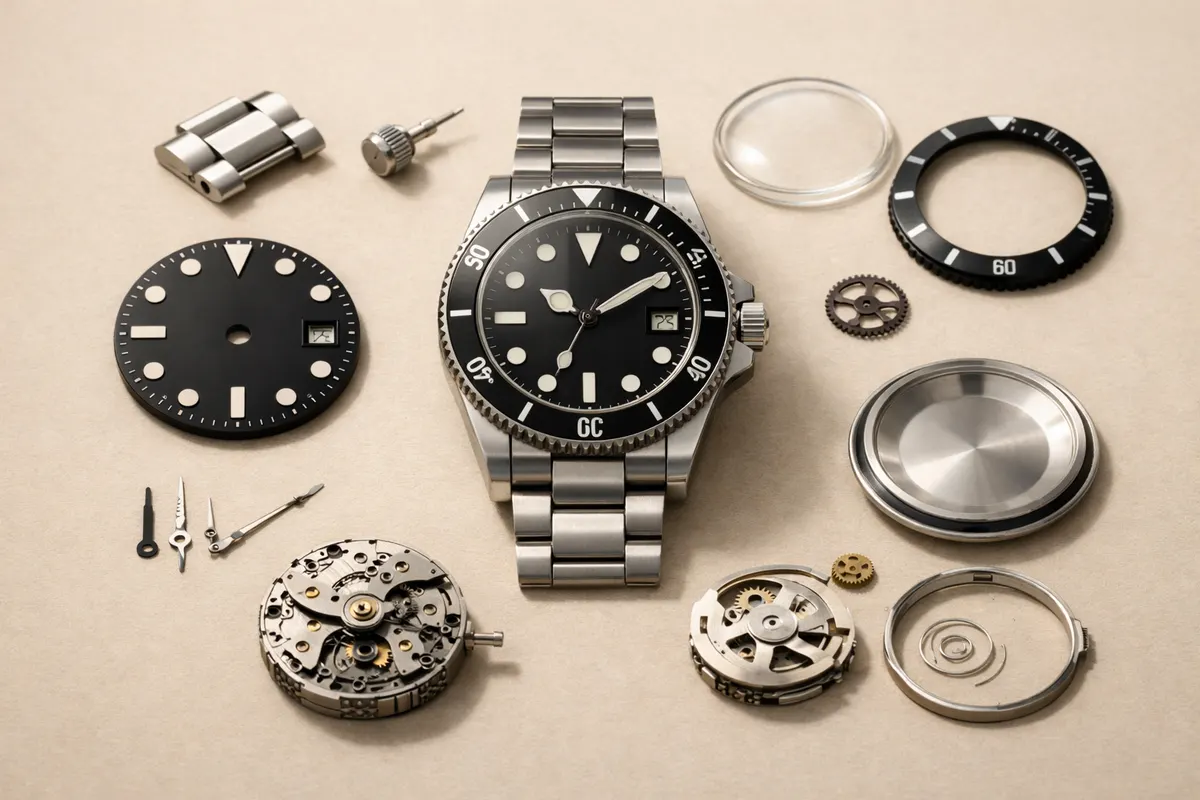
Quick answer: watch parts names at a glance
Watch parts names are the labels collectors and researchers use to describe visible features—dial elements, bezel types, hands, markers, crown shape, case finishes and lugs. Transcribing these parts from photos gives you searchable terms (for example “applied baton markers,” “onion crown,” or “12-hour rotating bezel”) that narrow results faster than brand guesses alone.
Start with a short list of high-value parts: the dial text and logo, bezel style, hand types, crown shape, crystal profile, lug configuration, and any distinctive indices or subdials. These visible clues let you separate lookalikes and focus on model families; they rarely prove authenticity or value by themselves, but they are the quickest way to build a productive identification search.
What watch parts names actually tell you
A watch part name is shorthand for a visible detail that has meaning across brands. For example, “Mercedes hands” refers to a specific hour hand shape popularized by one brand but later used by others; noting ‘‘Mercedes hands’’ points you to models that historically used that hand style without asserting pedigree or maker.
Some part names refer to function, like “chronograph subdials” or “date aperture,” while others describe finish and construction: “polished dauphine hands,” “sunburst dial,” or “coin-edge bezel.” Each label narrows the search space in image or catalog queries and helps you compare candidate models on design features rather than seller claims.
Careful transcription separates three sources of information: the manufacturer (official specs when available), seller statements (which can be incomplete or optimistic), and the photo evidence itself. Use part names to test claims—does a seller’s text match the visible crown, bezel, or dial printing?—and to record what you can verify independently from a picture.
Key visual clues and watch parts names
Not every visible detail is equally useful. Prioritize parts that tend to be model-specific or that historically help separate families: dial text and logo placement, bezel type and markings, hand shape, applied versus printed indices, subdial layout, and crown and lug shape. These clues often survive minor wear or aftermarket changes and are relatively easy to photograph.
Secondary clues—caseback engravings, bracelet endlinks, buckle style, and unique crystal profiles—can add confidence but may be altered during service or replaced. When you can’t see a part or it looks non-original, flag that as uncertain rather than discarding the entire identification.
Below are concise descriptions of common parts to transcribe, and how to spot them in photos.
- Dial logo and text: Exact wording, font style, and placement; note any small wording at 6 o’clock (e.g., ‘‘Swiss Made’’ or depth rating).
- Hands: Shape (syringe, cathedral, dauphine, Mercedes, baton) and finish (polished, lacquered, skeletonized).
- Indices/markers: Applied (three-dimensional) vs printed, luminous plots, Arabic numerals or baton markers.
- Bezel: Fixed vs rotating, insert type (aluminum, ceramic, bakelite), markings (count-up, countdown, 24-hour), and edge profile (coin, scalloped).
- Crystal profile: Domed, flat, or boxed crystal can be visible at certain angles; note distortion at edges.
- Crown: Screw-down vs push-down, guard shape, logo or unsigned; crown size relative to case can be diagnostic.
- Lugs and case shape: Lug width, drilled lug holes, integrated vs curved lugs, case finishes (brushed, polished).
- Subdials and complications: Position, spacing, and scale—chronograph tri-compax layouts vary by manufacturer.
Step-by-step: record watch parts names for identification
Work methodically so you can reproduce your search and test candidate models later. Start by photographing the whole watch on a neutral background, then capture close crops of the dial (straight-on), the crown and case profile (side view), and the bezel or any engravings. If you can’t get new photos, make a careful written log of the parts names and any exact dial text you can read.
Transcribe visible features into a short checklist using watch parts names as search terms. Combine a small number of high-confidence clues—brand or logo text if readable, hand type, bezel and index style—instead of dumping every unclear detail into a single query. This focused approach reduces false positives and surfaces plausible matches faster.
When comparing candidates, explicitly separate observations you can confirm in photos from claims you can’t: label items as high-confidence (clear, unambiguous details), partial (visible but possibly altered), or uncertain (likely hidden or modified). Use high-confidence clues to shortlist models and partial clues to refine that list.
- Photograph: full-watch, straight-on dial, crown/profile, caseback or bracelet clasp if visible.
- Transcribe: exact dial text, hand style, indices, bezel type, crown details, lug shape.
- Search: combine 2–4 high-confidence parts names (e.g., “sunburst dial applied indices Mercedes hands rotating 12h bezel”).
- Compare: open official catalogs and well-documented auction listings, matching photos to your checklist.
- Flag: mark anything that looks replaced (mismatched patina, non-period hands) and avoid assuming originality.
Examples: identifying watches from visible parts names
Example 1 — Diver-style watch: A watch shows a uni-directional bezel with a 60-minute count-up insert, large applied circular luminous indices, broad sword hands, and a screw-down crown with guards. Transcribing those parts names immediately points to sport or dive families; adding the dial depth rating (e.g., ‘‘200m’’) narrows it further to typical diver specifications and model ranges.
Example 2 — Vintage chronograph: A photo with three recessed subdials, pump-style pushers, and feuille (leaf) hands will steer searches toward mid-century chronograph models. Noting the subdial spacing—close together or widely spaced—helps separate movements and dial variants that different manufacturers used.
Example 3 — Dress watch: A slim case profile, polished dauphine hands, applied baton indices, and a small seconds subdial at 6 o’clock indicate a classic dress watch. When brand text on the dial is faint, these part names narrow the candidate set to mid-century dress pieces from specific manufacturers who favored that layout.
Limitations: what watch parts names and photos can’t confirm
Photos and part names are powerful for narrowing possibilities, but they can’t prove provenance, model reference authenticity, or movement caliber with certainty. Many components are swapped in service or by sellers—hands, crystals, bezels, or even dials—so a matching dial and hands does not guarantee an original factory configuration.
Serial numbers and internal engravings can identify production ranges and provenance, but you should not publish or widely share full serial numbers online. Treat serials as private identifiers: use them in direct communications with trusted experts, manufacturers, or authorised service centres rather than in public forum posts or image captions.
Value and authenticity require professional verification. A photo-based ID workflow can rule in likely matches and surface suspicious features, but only a physical inspection (movement checks, caseback opening by a qualified watchmaker, and provenance documents) can establish authenticity and market value with confidence.
- High-confidence outcomes: distinctive bezel+dial+hand combinations visible in clear photos.
- Partial outcomes: some matching features but signs of aftermarket parts or wear; needs more verification.
- Uncertain outcomes: hidden movement details, altered parts, or obscured markings—get a professional check.
- When to escalate: suspected counterfeit, high-value items, or if accurate valuation or service history is required.
Related guides
Try a focused identification workflow
Once you’ve recorded watch parts names and taken clear photos, use the Find This Watch tool to run a first-pass match: https://watchscanner.app/tools/find-this-watch. Treat the app as one practical next step after you collect visible evidence—use it to surface candidate models quickly, then verify serials and movement details privately with a trusted expert before drawing conclusions.
Take the next step →Frequently asked questions
Which watch parts are most useful when trying to identify a watch?
Start with parts that are both visible and model-specific: the exact dial text and logo placement, bezel type and markings, hand shape, and indices (applied vs printed). Crown shape and lug configuration are also diagnostic. Use a combination of 2–4 high-confidence clues rather than relying on a single feature, and capture photos straight-on and from the side so proportions and profiles are clear.
Can I identify the movement or caliber from just the dial and case photos?
Usually not with certainty. Some movements have distinctive subdial layouts or hand sweep characteristics that suggest a movement family, but many manufacturers used the same movements across different models and brands. Confirming the movement typically requires a caseback removal or clear documentation from the seller or an authorised service centre.
Should I include the serial number when asking others to help identify my watch?
Avoid sharing full serial numbers in public posts. Serial numbers are unique identifiers that can be sensitive; instead, provide visible part names, clear photos, and a cropped image or redacted serial if a specialist needs to confirm production range. Share full serials only privately with trusted experts, the manufacturer, or verified service providers.
How many photos and which angles should I include when describing a watch by its parts names?
Aim for at least four: a straight-on dial shot, a full-watch photo showing proportions, a side/profile image showing crown and crystal profile, and a close crop of the bezel or any distinctive marking. If the clasp, caseback, or bracelet endlinks are visible and appear original, include those too. Good lighting and neutral backgrounds reduce glare and reveal finish and texture.